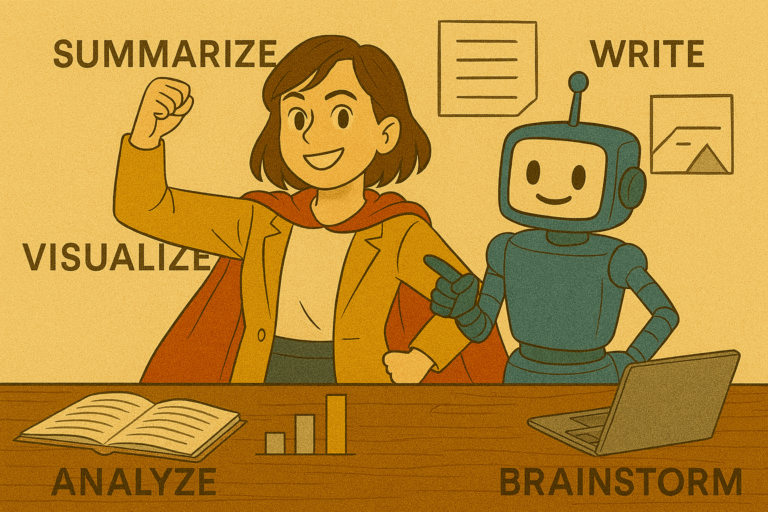
Entrepreneurs often work with more ideas than time. That reality shapes how many of us build and run our businesses, especially when we move between roles in a single day. In my recent session with the Center for Women’s Entrepreneurship, we focused on a simple question: “How can small business owners begin using AI in ways that save time, improve clarity, and protect judgment?”. As a solopreneur myself, I see this question show up in my own work every week. This post captures the core ideas from that webinar and offers a clear place to begin.
Why Entrepreneurs Need a Smarter Start
The group that joined the session reflected a pattern I see often. Most used AI occasionally or weekly, but only for small tasks. When asked for the first word they associated with AI, the responses ranged from risky and scary to supportive and full of potential. This mix captures where many entrepreneurs are: curious, open to learning, and aware that AI is now part of daily work, yet still cautious about how to begin.
The goal of the session was not mastery. It was to build confidence, provide clarity, and offer responsible first steps to get started with AI.
What You Need to Know Before You Try AI
You do not need technical expertise to use AI well. You need a simple model for how it fits into your work and how to communicate with it clearly.
AI can act like a coworker in defined roles. In the webinar we talked about using AI as an intern, assistant, editor, analyst, brainstorming partner, or designer. Each role has limits, yet each can reduce pressure on a founder who already moves between many responsibilities.
AI creates value in two main ways.
- Productivity value comes from saving time, reducing repetitive work, and making decisions with more information.
- Opportunity value comes from exploring new ideas, reaching new customers, and learning faster.
The four examples in the next section show both types of value in action. The most important skill is not coding. It is clear communication. English now functions as the programming language for most AI tools. Context, intent, and tone matter.
Four Quick Wins to Help You Get Started
To make this practical, the webinar used a solopreneur persona, curious about how to incorporate it into her daily work.
Priya is the founder of Bright Hearth Candles. She makes sustainable candles in reclaimed glass and serves customers who value intentional living. She runs the business alone and faces the same constraints many solo founders face.
- Limited time
- Broad responsibility
- A strong mission
- Uncertainty about where AI might help
I demonstrated four ways that Priya could use AI in her business to both capture productivity and opportunity value.

1. Write a clear brand story
Priya had a story in draft form but struggled to shape it for her website. She asked AI to act as a brand strategist and create a version focused on craft, community impact, and her transition from engineer to entrepreneur. The result gave her a solid start she could refine in her own words.
Lesson: let AI create a draft. Keep the final voice human.
2. Research funding opportunities
Grant research can consume hours. Priya gave AI three articles about small business grants and asked for a summary, an eligibility comparison, and a short table of deadlines and award amounts. It completed the task in minutes.
Lesson: AI can scan and summarize quickly. You remain responsible for confirming accuracy.
3. Create a product image
Priya needed a visual for her website. She gave AI a clear description of her brand, materials, and photography style. She received a concept image that shaped her direction for a later photoshoot.
Lesson: use AI for early concepts. Keep final brand assets aligned to your identity.
4. Learn from complex material
Priya wanted to understand how soybean tariffs might affect her supply chain. NotebookLM converted three dense reports into a concise audio lesson she could play while working.
Lesson: AI can transform complex material into formats that fit your day.
If you run a services business, consulting practice, or online shop, you can adapt each of these patterns to your own context.
What I Learned from the Audience
Although the group was small, the poll and chat responses pointed to shared themes. Many wanted support with marketing and workflow automation. Several raised questions about accuracy, privacy, and bias. Others were surprised by how approachable prompting became once they saw clear examples. Comments such as “refining questions makes all the difference” reflected a shift in confidence.
This reinforced my belief that most founders want to experiment. What they lack is a clear place to start and practical ways to avoid mistakes.
Practical Guardrails for Responsible Use
AI can be helpful only if used with care. I raised three risks that are critical for all AI users to be aware of:
- Data
- Decide what you share. Turn off model training. Avoid uploading confidential files. Check memory settings in your tools.
- Judgment
- AI can sound confident even when it is wrong. Preserve your critical thinking. Verify claims. Challenge assumptions.
- Human voice
- Your values and tone should remain yours. AI should produce drafts and options. You shape the final product.
In the session I drew briefly on Anthropic’s 4D framing to emphasize that good AI use is not only about intentional delegation, but also about description, discernment, and diligence. Responsible use is a key part of protecting your business and your reputation.
A Clear Starting Point
Begin with one use case, one tool, and one clear prompt. Review the output with care. Check accuracy before sharing. Add one safety practice. Try something new the following week.
All major AI platform vendors offer an academy or a skills portal to build expertise with AI with short, practical lessons that strengthen foundational skills without requiring technical expertise. Check out the Courses page to begin your structured learning with AI.
This steady approach builds fluency and confidence while keeping your judgment at the center.
Ready to try this in your own work?
Choose one task from your week where you could use a draft, a summary, a visual, or a short lesson. Apply one of Priya’s patterns, write one clear prompt, and review what you get back. If you want more structure, visit the Courses page on this site and select one AI learning resource to work through this month.
Note: All images were created using AI prompts.
Discover more from DEEPLY Product
Subscribe to get the latest posts sent to your email.